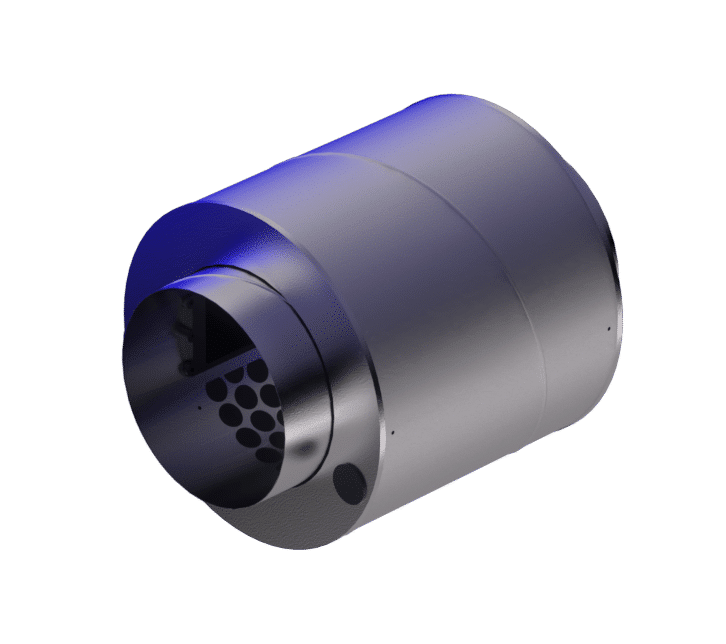
The acoustic comfort of a building depends on elements that go unnoticed such as the ducts, diffusers, and silencers hidden within the HVAC (Heating, Ventilation, and Air Conditioning) systems. Yet, the noise these systems generate can have a direct impact on well-being, productivity and even health. One of the most effective solutions to mitigate this problem is the porous absorber for HVAC systems. Want to know more? Vibiscus tells you everything on this post.
Porous absorbers are acoustic materials designed to absorb sound energy rather than reflect it. Within HVAC systems, they are placed inside ducts, silencers or ventilation units to reduce the transmission of noise generated by fans, air turbulence or mechanical vibrations.
In simple terms, when sound waves travel through the air and meet a porous surface, part of the acoustic energy penetrates the material and is converted into heat through friction within its microscopic structure. This results in a significant reduction in noise intensity, particularly at medium and high frequencies.
Traditionally, porous absorbers used in HVAC systems are made from materials such as mineral wool, fiberglass or foam. Their effectiveness depends largely on their porosity, thickness and airflow resistivity. However, while these conventional materials offer satisfactory performance, they often come with drawbacks such as aging over time, reduced efficiency under high humidity and limited adaptability to complex duct geometries. This is where Vibiscus technology marks a major turning point.
principle: the dissipation of acoustic energy through friction and viscous losses. When a sound wave enters a porous material, air particles oscillate and move within the material’s microchannels. As they encounter resistance, their kinetic energy transforms into heat through a process known as viscous damping. This microscopic friction reduces the amplitude of the wave, effectively lowering the sound level transmitted beyond the absorber.
In an HVAC context, porous absorbers serve several critical functions:
The challenge for engineers is to achieve this sound absorption without impairing airflow performance or energy efficiency. Porous materials must therefore be carefully designed to maintain the system’s pressure balance and thermal management capabilities.
Vibiscus has redefined what a porous absorber can be. While traditional absorbers rely solely on passive physical properties, our technology integrates smart materials, sensors, and dynamic control mechanisms to actively adapt acoustic performance in real-time. It is an hybrid solution between traditional absorption and active control
Conventional soundproofing approaches in HVAC systems typically fall into two categories:
Vibiscus bridges the gap between these two methods. Rather than adding counter-sound waves, its technology uses a network of microphones and movable membranes to dynamically alter the acoustic impedance of the air around it. This means the material can tune its own absorption characteristics to the specific frequency spectrum of the noise, achieving optimal performance at all times.
Unlike ANC systems, Vibiscus does not emit additional sound energy. It simply enhances the natural absorption properties of the material. This approach is far more energy-efficient, robust, and adaptable to complex HVAC geometries.
Another distinctive advantages of Vibiscus technology is its integration of artificial intelligence. By continuously analyzing acoustic signals, the system can identify noise patterns and adjust its behavior accordingly.
Porous absorbers reduce sound energy directly through material interaction, without emitting additional noise. This makes them more stable, energy-efficient and environmentally friendly than active control systems.
Yes. The modular design of Vibiscus absorbers allows for integration into most existing ventilation infrastructures without major modifications
No. Vibiscus is designed to maintain optimal airflow efficiency. Its smart control of acoustic impedance ensures that sound absorption does not compromise system ventilation.
Quite the opposite: Vibiscus technology consumes far less energy than active noise cancellation systems since it relies primarily on enhanced material properties and intelligent adjustment.
The system effectively targets a wide range of frequencies, including fan noise, duct resonance, and low-frequency turbulence, making it ideal for comprehensive HVAC acoustic management.
Porous absorbers play an essential role in ensuring acoustic comfort in modern HVAC systems, but Vibiscus has taken this concept to the next level. By combining smart materials, real-time adaptive control, and energy efficiency, Vibiscus offers an innovative solution that redefines how we think about sound management in ventilation systems. Want to know more or adopt our solution? Contact us now!