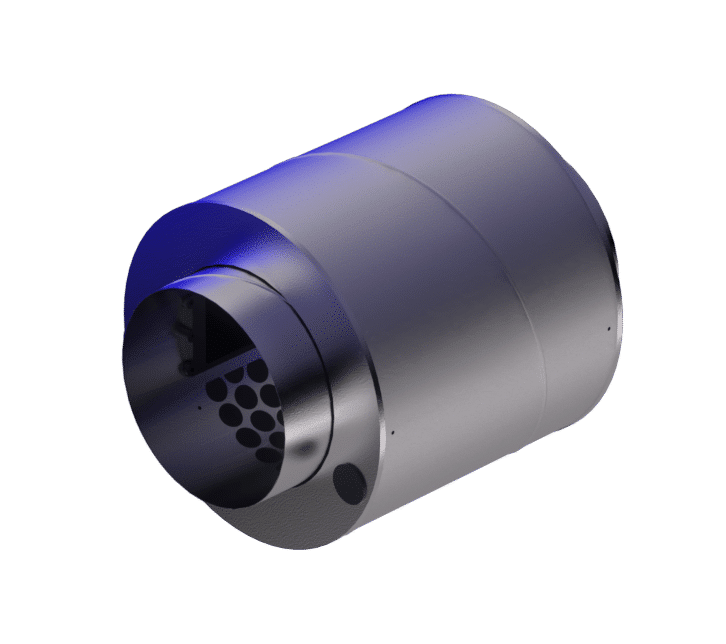
In many buildings, acoustic comfort depends as much on the architecture as on the technical equipment installed. Among this equipment, ventilation systems play a central role. They ensure air renewal, regulate temperature, and contribute to the quality of the indoor environment. However, they are also a frequent source of noise pollution. It is precisely to address this problem that HVAC vent silencers were developed.
The noise generated by a ventilation system can have several origins. Fans, compressors, and motors are the primary sources of noise. Their mechanical operation produces vibrations that are transmitted through the ducts and then into the rooms they serve.
In addition to this, there is aerodynamic noise. When air circulates at high speed in a ventilation network, it can cause turbulence, particularly at bends, grilles, or where the cross-section narrows. These phenomena create whistling or continuous hissing sounds that can become tiring in the long term.
In industrial facilities or large commercial buildings, the ductwork can also act as a veritable sound box. The noise produced by a machine can travel several tens of meters and be audible in areas far from the source.
These noise nuisances are not just a matter of comfort. In some work environments, they can lead to decreased concentration, fatigue, or communication difficulties. In buildings open to the public, such as hotels, hospitals, or offices, they can also affect the overall perception of the quality of the space.
To reduce the noise of a ventilation system, several approaches can be considered. The first is to act at the source, by selecting quieter equipment or optimizing air velocities. However, this solution is not always possible, especially in existing installations.
Another approach relies on the acoustic insulation of the ducts. Absorbent materials can be placed around or inside the ductwork to limit noise propagation. This method is effective for certain frequencies, but it requires space and can complicate integration into existing installations.
HVAC vent silencers are a more targeted solution. They are installed directly in the ducts, near noise sources or sensitive areas. Their role is to absorb sound energy while allowing air to circulate without creating excessive pressure losses.
Traditional solutions most often rely on porous materials, such as foams or fibers, capable of transforming acoustic energy into heat. Although widely used, these technologies have certain limitations. Their effectiveness depends heavily on the thickness of the material and the frequencies to be attenuated. In space-constrained environments or those requiring precise adaptation, they may prove insufficient.
Faced with the limitations of traditional solutions, new technological approaches are emerging. The HVAC vent silencer developed by Vibiscus is part of this innovative trend. It is not simply a conventional absorbent material, but a compact and modular device capable of adapting its acoustic properties to the actual needs of the system.
Our technology is based on an array of microphones and movable membranes. These elements modify the acoustic characteristics of the air circulating in the duct. The resulting absorbent surface can be configured to target problem frequencies, providing more precise noise reduction.
Unlike traditional active noise reduction systems, our approach does not involve adding one sound to mask another. Our device acts as an enhanced absorbent material, capable of dissipating sound energy effectively. This solution thus positions itself halfway between conventional passive silencers and active systems, combining the advantages of both approaches.
One of the major advantages of our technology is its compactness. Designed to integrate into a wide variety of ventilation ducts, the system can be installed without major modifications to the existing infrastructure. This simplified integration makes it a particularly attractive solution for buildings where technical space is limited.
Our device is also designed to reduce noise without compromising ventilation performance. Air passes through an optimized absorbent surface, which attenuates noise while maintaining efficient system operation.
An HVAC vent silencer is a device installed inside or along ventilation ducts to reduce the propagation of noise generated by fans, airflows, or mechanical equipment.
They are usually placed near noise sources, such as fans or air handling units, or close to sensitive areas where acoustic comfort is important.
A properly designed silencer is engineered to minimize pressure losses while reducing noise. Modern solutions aim to combine acoustic efficiency with optimal airflow.
Instead of relying solely on passive absorbing materials, Vibiscus uses a network of microphones and movable membranes to adjust the acoustic properties of the air. This allows for more precise noise reduction in complex environments.
Yes, many silencers, especially compact and modular solutions, are designed to integrate into existing ventilation ducts without major structural modifications.
Want to know more about our HVAC vent silencer or adopt our technology? Contact us!