Noise pollution has become a critical issue across modern industrial, commercial and urban environments. HVAC systems, ventilation ducts, cooling towers, data centers, heat pumps and industrial equipment generate constant acoustic emissions that directly affect comfort, productivity and even health. For decades, the industry mainly relied on two approaches to manage noise: passive sound absorption and Active Noise Cancellation (ANC). While both methods remain useful in specific situations, they also present limitations when confronted with complex industrial environments, evolving frequencies or airflow-intensive systems.
Today, new expectations are emerging. Companies are no longer looking only for noise reduction. They want intelligent, adaptable and energy-efficient sound control technologies capable of integrating seamlessly into existing infrastructures without compromising system performance. This shift explains why innovative sound control technologies such as Vibiscus are attracting growing attention in the field of industrial acoustics. But what is Vibiscus? We tell you everything on this page.
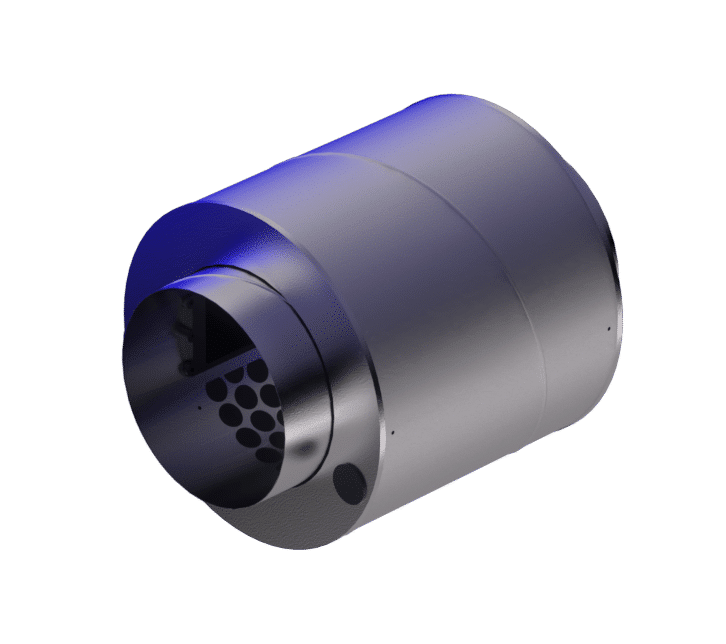
Vibiscus is an innovative sound control technology designed to reduce unwanted noise in ventilation systems and complex industrial environments. At its core, the system relies on a network of microphones and movable membranes capable of dynamically modifying the acoustic properties of the surrounding air. This creates a configurable absorbent surface specifically designed to dissipate sound energy more efficiently.
Unlike traditional acoustic materials that remain passive and static, Vibiscus continuously adapts to the acoustic environment in which it operates. This distinction is important because industrial noise is rarely stable. HVAC systems, ventilation ducts, cooling equipment and air handling units constantly generate fluctuating sound frequencies depending on airflow, operating speed or thermal demand.
Traditional sound absorbers often struggle to maintain high efficiency across these changing acoustic conditions. The Vibiscus approach introduces a more flexible and intelligent way of managing sound propagation.
The technology, compact and highly modular, can be integrated into a wide variety of ventilation systems and duct geometries. As air passes through the system equipped with the adaptive absorbent surface, noise is absorbed and dissipated before spreading throughout the surrounding environment.
One of the most remarkable aspects of Vibiscus is that it does not operate like conventional Active Noise Cancellation systems. Traditional ANC technologies work by generating additional sound waves designed to counteract incoming noise. While effective in certain applications, this method can become energy-intensive and difficult to implement in large industrial environments or complex airflow systems.
Vibiscus follows a different philosophy. Rather than adding more sound into the environment, the system behaves like a “boosted” acoustic material capable of intelligently adapting its sound absorption properties in real time.
Innovation in acoustics does not simply mean reducing noise levels. True innovation is the ability to combine efficiency, adaptability, energy performance and seamless integration into real-world industrial environments. This is precisely where Vibiscus stands apart from more traditional approaches.
One of the major limitations of conventional acoustic solutions is their rigidity. Passive absorbers are designed with fixed acoustic properties. Once installed, their performance remains relatively constant regardless of how operating conditions evolve. Yet industrial noise is dynamic by nature. Ventilation systems, data centers, cooling towers and HVAC infrastructures constantly experience variations in airflow velocity, operating cycles and sound frequencies. A fixed absorber cannot always adapt efficiently to these changing conditions.
Vibiscus introduces a new level of acoustic precision through advanced AI integration. Our innovative sound control technology continuously analyzes the surrounding acoustic environment and adjusts the behavior of its movable membranes accordingly. This adaptive capability allows more targeted sound dissipation and improved overall performance.
Another important innovation concerns energy efficiency. Traditional Active Noise Cancellation systems rely on generating additional sound signals. This process can become complex and energy-consuming, particularly in large industrial spaces or systems with complicated geometries. Vibiscus avoids this issue entirely. Because the technology focuses on absorbing and dissipating sound rather than masking it with opposing waves, the overall energy demand remains significantly lower. This makes the system particularly attractive for industries seeking both acoustic optimization and energy efficiency.
The versatility of Vibiscus makes our innovative sound control technology suitable for a broad range of industrial and commercial applications where airflow and noise generation are closely connected. HVAC systems are one of the most obvious use cases. Ventilation ducts, air handling units and mechanical ventilation systems continuously generate aerodynamic noise and vibrations that can propagate throughout buildings.
In office buildings, hospitals or commercial infrastructures, reducing this noise directly improves occupant comfort and productivity. Heat pumps are another important application. As these systems become more widespread in residential and urban environments, their acoustic impact is increasingly scrutinized. Compressors, fans and airflow turbulence may create persistent noise nuisances, especially in dense areas. Vibiscus can help reduce these acoustic emissions while preserving airflow efficiency.
Data centers also face growing sound-control challenges. Cooling systems operate continuously to maintain stable thermal conditions for servers and electronic infrastructures. The resulting noise pollution can become significant both inside facilities and in surrounding areas. Because Vibiscus is designed to handle complex airflow geometries and fluctuating acoustic conditions, it is particularly relevant for these environments.
Cooling towers and industrial coolers are another important field of application. These systems generate high levels of aerodynamic and mechanical noise due to fan operation and air circulation.
Laboratories and research facilities may also benefit from advanced sound control technologies. In environments where concentration, precision and equipment stability are essential, reducing background noise can significantly improve working conditions.
More broadly, any industrial infrastructure relying on ventilation, cooling or airflow-intensive systems may integrate Vibiscus technology as part of a modern acoustic management strategy.
Its adaptability, AI-driven precision and energy-efficient operation position the technology as a promising solution for the future of industrial noise control.
Traditional insulation relies on fixed passive materials. Vibiscus, an innovation sound control technology, uses adaptive acoustic surfaces capable of adjusting their sound absorption properties dynamically.
No. Unlike Active Noise Cancellation technologies, Vibiscus does not add sound waves to mask noise. It absorbs and dissipates sound directly.
Yes. The technology is compact and modular, allowing integration into existing ventilation infrastructures and complex duct systems.
HVAC, data centers, laboratories, industrial cooling systems, heat pumps and ventilation-intensive infrastructures can all benefit from advanced sound control solutions.