Modern offices have changed. Open layouts have replaced partitions, ventilation systems have become more sophisticated and collaborative work has become the norm. These transformations have improved flexibility and communication, but they have also created a challenge that many organizations underestimated: noise. Office noise is rarely dramatic. It does not usually resemble industrial machinery or heavy infrastructure. Instead, it settles gradually into everyday work through conversations, airflow, equipment hum and overlapping activities. Over time, this constant acoustic presence affects concentration, comfort and the overall perception of workspace quality. That is why companies increasingly search for sound absorber devices for offices, and in this search, Vibiscus may have the perfect solution for you!
When people think about reducing noise, they often imagine adding more material. More panels. More barriers. More insulation. Traditional acoustic treatment generally relies on absorbing, reflecting or blocking sound waves using passive materials. These approaches remain effective in many situations, but office environments present specific constraints. Workspaces evolve. Layouts change. Ventilation requirements remain high. Noise sources move throughout the day. A solution designed for one configuration may become less relevant after a simple reorganization.
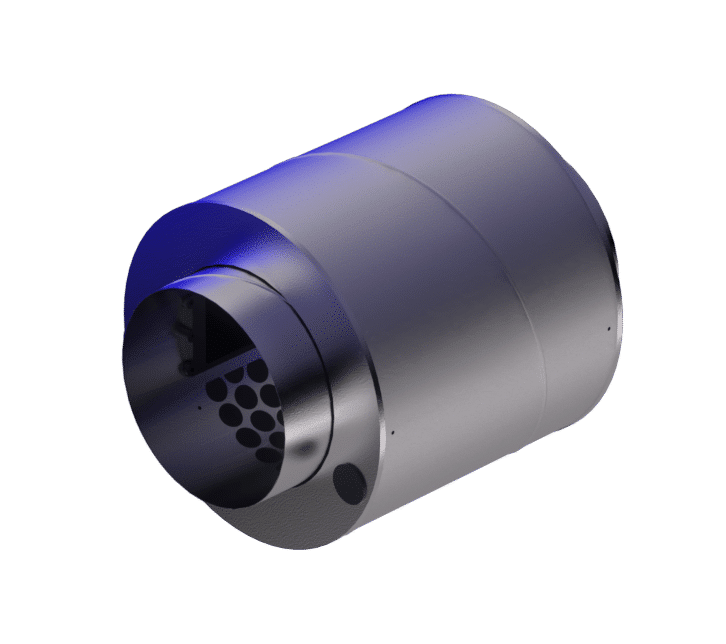
Our sound absorber device for offices was developed with a different philosophy. Rather than generating additional sound to counteract unwanted noise, our system acts as an advanced absorbent surface capable of modifying how surrounding air behaves acoustically.
Its operation combines a network of microphones with mobile membranes to adapt the acoustic properties of the environment. The result is not sound masking. It is controlled absorption and dissipation. Air passing through a system equipped with this absorbent surface can be treated so that unwanted acoustic energy is reduced.
Unlike conventional Active Noise Cancellation approaches, Vibiscus does not introduce additional sound into the environment. Instead, it positions itself between traditional passive absorption and active control strategies. That makes it especially interesting for environments where comfort, precision and energy efficiency matter.
For office applications, this creates new possibilities. Rather than redesigning entire interiors, acoustic treatment can become more integrated into existing airflow and infrastructure strategies.
Office acoustics are often approached as a compromise. Improve comfort and risk reducing flexibility. Preserve airflow and accept noise. Enhance collaboration but lose concentration. Vibiscus technology was designed to challenge this type of trade-off.
Its innovation does not come from introducing a completely separate acoustic layer into buildings. Instead, the technology focuses on making acoustic treatment more adaptive and easier to integrate. Several characteristics contribute to this positioning. First, the system is compact and highly modular. That means installations can be adapted to different environments rather than imposing a standardized configuration.
Second, Vibiscus combines sound control with airflow considerations. This point is often underestimated in offices. Many unwanted sounds originate directly from ventilation systems and air circulation networks. Traditional acoustic devices sometimes reduce noise at the expense of airflow efficiency.
Vibiscus aims to maintain improved airflow management while contributing to acoustic comfort. Third, the integration of AI allows more precise sound reduction. The objective is not to create silence, which would often feel unnatural in an office, but to improve acoustic quality where people actually work. Finally, the approach is designed for integration into existing structures.
By reducing sound pollution while limiting structural modifications, our sound absorber device for offices allows companies to improve comfort without completely redesigning their spaces.
There is no such thing as a typical office anymore. Some companies operate large open spaces. Others organize teams into flexible zones. Some prioritize hybrid work environments. Others maintain enclosed workstations with high technical requirements. And then, acoustic expectations vary accordingly.
That diversity is precisely why office sound control should not rely on a single fixed formula. A compact meeting area does not create the same acoustic challenges as a floor dedicated to collaborative work. Likewise, offices heavily dependent on ventilation infrastructure often experience persistent background noise that conventional furnishings cannot fully address.
Our sound absorber device for offices was designed with this variability in mind. Its modular architecture allows deployment across different configurations and technical constraints. Whether integrated into ventilation-related applications or introduced into environments where airflow and acoustic performance must coexist, the objective remains the same: reduce unnecessary sound while preserving usability.
Want to know more or profit from our sound absorber device for offices? Discover it now on our website.
A sound absorber device reduces unwanted acoustic energy inside office spaces to improve comfort and limit sound propagation. Different technologies exist, including traditional absorbent materials and more advanced adaptive approaches.
No. According to its design principles, Vibiscus does not generate additional sound to mask existing noise. It works through controlled sound absorption and dissipation.
Yes. One of the stated advantages of our technology is its ability to integrate into existing structures while remaining compact and modular.
Absolutely. Ventilation and airflow systems are common contributors to office noise, particularly in modern buildings designed around open and connected spaces.