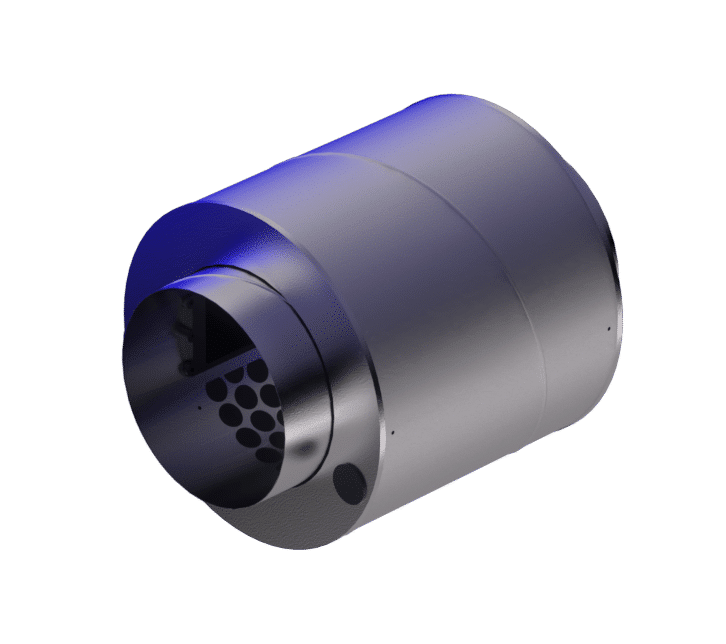
HVAC systems are responsible for a significant amount of noise that can quickly become bothersome for building occupants. By creating a constant background noise, they can lead to stress or discomfort, and even prove critical in complex environments. To address these issues, many professionals are looking for silencers. In this regard, you can consider the Vibiscus acoustic absorber for HVAC systems. We’ll explain everything.
Noise in HVAC systems originates from several combined phenomena. At the source, mechanical equipment such as fans, blowers and motors inevitably produce vibrations and airborne noise. Even when these components are well designed, their operation at varying speeds creates tonal and broadband noise that enters the ventilation network.
Once inside the ducts, airflow itself becomes a major contributor. High air velocities, turbulence, sudden changes in duct geometry or poorly designed fittings can all generate aerodynamic noise. This sound then travels along the ductwork, sometimes over long distances, and is radiated into occupied spaces through diffusers or duct walls.
Traditional approaches to HVAC noise reduction have focused on passive elements such as lined ducts or bulky silencers. While these solutions can be effective in certain frequency ranges, they also have limitations, particularly in low frequencies and in installations with strict space or airflow constraints.
That’s why you can now turn to an acoustic absorber for HVAC systems.
An acoustic absorber for HVAC systems is designed to reduce sound energy through interaction with a material or structure. In ventilation applications, absorbers are typically integrated directly into the ductwork or installed as dedicated silencers.
Conventional acoustic absorbers rely on porous materials such as mineral wool or foam. As sound waves penetrate these materials, friction between air particles and the internal structure dissipates acoustic energy. This approach is well known and widely used, but it is not without drawbacks. Porous absorbers require significant thickness to be effective, particularly at low frequencies. They can also introduce pressure drops, affect airflow efficiency and raise concerns related to hygiene, aging or particle release.
Moreover, traditional absorbers are passive by nature. Their acoustic performance is fixed once installed and cannot adapt to changing operating conditions, such as variable fan speeds or fluctuating airflow rates. In modern HVAC systems, which increasingly rely on dynamic control and energy optimization, this lack of adaptability becomes a real limitation.
As buildings become more compact and performance-driven, the need for smarter, more efficient acoustic absorbers has grown. This evolution has paved the way for technologies that go beyond classical porous materials and bring active intelligence into sound absorption. And that’s where Vibiscus offers his innovative acoustic absorber for HVAC systems.
The solution developed by Vibiscus represents a significant shift in how acoustic absorption is approached in HVAC systems. Instead of relying solely on passive materials, Vibiscus has designed what can be described as a “boosted material” that combines physical absorption with intelligent control.
The heart of our technology is a network of microphones and mobile membranes integrated into a compact and modular device. These elements continuously interact with the surrounding acoustic field inside the duct. By modifying the acoustic properties of the air itself, the system creates an effective absorbing surface that dissipates sound energy without generating additional noise.
Unlike Active Noise Control (ANC) solutions, Vibiscus does not inject anti-noise to cancel unwanted sound. ANC systems require precise phase alignment and are often limited to specific frequencies or simple geometries. Vibiscus, by contrast, enhances absorption rather than cancellation, making the solution inherently more stable, energy-efficient and adaptable to complex duct layouts.
Artificial intelligence plays a key role in this process. The system analyzes incoming noise in real time and adjusts its behavior accordingly. This allows for precise attenuation across a broad frequency range, including low frequencies that are traditionally difficult to treat with passive absorbers. At the same time, airflow is preserved and ensures that ventilation performance and indoor air quality are not compromised.
Not all HVAC systems require dedicated acoustic treatment, but in many buildings, noise levels become an issue once systems are in operation. Acoustic absorbers for HVAC systems are particularly important in offices, healthcare facilities, residential buildings and industrial sites where comfort or regulatory limits must be met.
Traditional silencers rely on passive materials with fixed performance. Vibiscus uses an intelligent, adaptive approach that modifies the acoustic properties of the air, providing more efficient and flexible noise reduction without adding bulky materials or significant pressure losses.
Yes. Our system is designed for seamless integration into existing ductwork. This makes it suitable for renovation projects where noise problems are identified after installation or where space constraints limit conventional solutions.
No. Since Vibiscus focuses on absorption rather than sound cancellation, its energy consumption is significantly lower than many active noise control systems. This contributes to an overall energy-efficient HVAC design.
The technology is applicable across a wide range of buildings, including commercial offices, industrial facilities, hospitals, laboratories and residential developments, wherever HVAC noise needs to be controlled effectively.
Acoustic comfort is no longer a secondary consideration in HVAC design. As expectations rise and regulations become more stringent, the choice of an acoustic absorber for HVAC systems has a direct impact on building performance and user satisfaction. By combining intelligent control, modular design and energy-efficient absorption, Vibiscus offers a modern answer to a long-standing challenge and redefines how sound is managed in ventilation systems.