In modern buildings, heating, ventilation, and air conditioning systems ensure air circulation, which is essential for thermal comfort and indoor air quality. However, they also generate a nuisance that is often underestimated: noise. Mechanical vibrations, turbulent air movements, resonance in ducts… The acoustics of an HVAC system can quickly become a sensitive issue, particularly in offices, hospitals, hotels, laboratories and apartment buildings.
The need for an effective acoustic silencer for HVAC systems has therefore never been more crucial. The difficulty is that traditional solutions are now reaching their limits. It is precisely to meet this challenge that Vibiscus has developed a technology designed to transform the way noise is treated in ventilation systems. We explain everything.
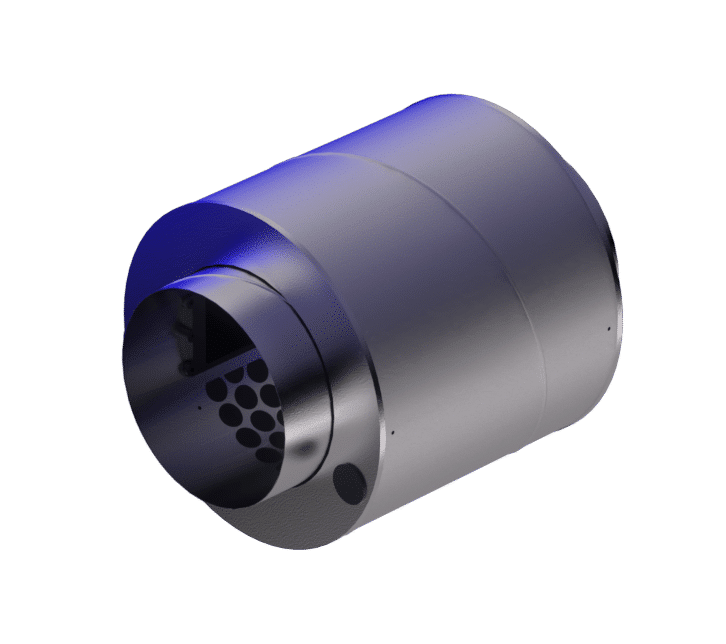
The acoustic silencer for HVAC systems developed by Vibiscus provides a completely new solution to the problem of noise in air systems. It is not a conventional silencer that relies solely on the thickness of absorbent materials, nor is it an active noise control (ANC) system that adds sound to suppress another.
The Vibiscus solution is based on a different principle: a dynamic acoustic surface capable of modifying certain properties of the air in real time to absorb and dissipate noise before it propagates through the network.
Its architecture is based on three key elements:
The whole forms a modular system capable of offering a level of noise attenuation that is impossible to achieve with conventional passive silencers, while remaining much more economical than an active device.
Passive silencers still play a role in many installations, but they are bulky, inflexible, and lose effectiveness when the network configuration is complex or the interfering frequencies are low.
Vibiscus’ acoustic silencer for HVAC systems offers an alternative approach, using a “boosted” acoustic material that not only filters or diffuses noise, but also modifies the sound environment in the duct to absorb noise in a targeted manner. This results in stable performance, even in non-linear networks that are constrained or subject to flow variations.
ANC systems have long been considered as the future of acoustic treatment, but their use in air ducts has limitations: they add additional sound, consume a lot of energy, their effectiveness is highly dependent on geometry and internal reflections and they struggle to handle a broad sound spectrum.
Vibiscus technology does not add any sound. It absorbs and dissipates. This distinction changes everything, as it translates into lower energy consumption, greater efficiency on complex geometries and easier integration into existing ducts.
To understand the benefits of Vibiscus’ acoustic silencer for HVAC systems, it is important to understand the limitations faced by acoustic engineers in ventilation networks. In a duct, noise generally comes from fans, flow variations, turbulence, air-material interactions and the natural propagation of sound in a confined environment.
Passive silencers attempt to reduce these phenomena by inserting absorbent materials, but they are dependent on their thickness and the available space. In a context where HVAC systems need to be more compact, more efficient and more discreet, the limitations of these devices are becoming apparent.
Vibiscus technology is based on a different approach, founded on three pillars: a configurable acoustic surface, continuous sound analysis, and a modular and compact design.
The system’s mobile membranes are capable of modifying their physical properties (displacement, tension, potential absorption). Depending on the noise detected by the microphones, the system adjusts the way it processes sound waves.
Furthermore, unlike passive silencers, which often require long lengths to be effective, the Vibiscus system is compact, easy to integrate, compatible with different diameters and types of ducts, and adjustable to specific needs.
Every building has its own acoustic dynamics. Between duct configuration, air flow rates, pressure levels, sound sources and integration constraints, no two cases are alike. That’s why Vibiscus offers customized support for the deployment of its acoustic silencer for HVAC systems. Our engineers take the time to understand the configuration of your installations, your operational constraints, and your acoustic objectives.
To learn more, have your installation analyzed, or talk to our engineers, contact us. Our team is at your disposal.