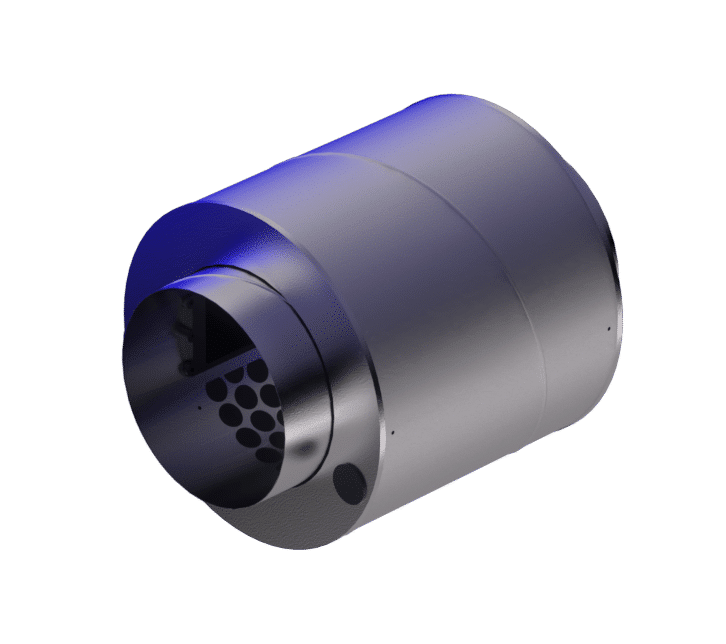
Data centers never really sleep. Behind every cloud service, streaming platform or enterprise application, there is an infrastructure operating around the clock. This continuous activity inevitably generates noise. While the sound produced inside server rooms is expected, the noise emitted by cooling equipment, ventilation systems and air handling units can become a significant challenge both inside the facility and in its surrounding environment. But finding the right data center noise reduction device means finding a solution capable of improving acoustic performance without compromising airflow, cooling efficiency or system reliability. And Vibiscus is one of them.
Most noise generated by data centers originates from the infrastructure that keeps servers operating safely. Cooling towers, HVAC systems, ventilation ducts and high-capacity fans continuously move large volumes of air. These installations are essential for thermal management, yet they also create persistent broadband noise that can propagate throughout the building and beyond its walls. Managing this type of acoustic pollution is challenging because airflow itself cannot simply be reduced. Any solution must preserve cooling performance while improving acoustic comfort. This is precisely the philosophy behind Vibiscus.
Rather than relying on conventional sound masking techniques, Vibiscus introduces a different approach to noise control. Its technology combines a network of microphones with mobile membranes capable of modifying the acoustic properties of the surrounding air. The resulting absorbent surface can be configured according to the application’s requirements. As air passes through the system, unwanted sound energy is absorbed and dissipated.
Unlike Active Noise Cancellation (ANC), our data center noise reduction device does not emit additional sound to cancel existing noise. Instead, it behaves like an enhanced acoustic material designed to improve sound absorption while remaining compatible with complex airflow geometries commonly found in industrial ventilation networks.
Noise reduction technologies generally fall into two broad categories.
Each method has advantages depending on the application. Passive systems are proven and robust but can become bulky, particularly when significant attenuation is required. Active noise cancellation performs well under specific operating conditions but requires additional sound generation and may be less suitable for certain industrial geometries.
Vibiscus positions itself between these traditional approaches. Instead of creating new sound, it enhances acoustic absorption through an intelligent and adaptive surface. This delivers several practical benefits. Our noise reduction device for data centers integrates artificial intelligence to achieve highly precise noise reduction while remaining energy efficient. Its modular architecture allows adaptation to various ventilation configurations instead of relying on one fixed design.
Another important advantage concerns integration. Data centers continuously evolve as cooling capacities increase and infrastructure expands. Acoustic solutions must therefore fit within existing installations rather than requiring extensive structural modifications. Vibiscus has been designed precisely with this flexibility in mind. Its compact format facilitates integration into numerous ventilation systems while helping operators improve acoustic performance without fundamentally redesigning their facilities.
No two data centers are identical. Some facilities occupy relatively small technical rooms within office buildings. Others span thousands of square meters and support hyperscale cloud infrastructure. Cooling technologies also differ significantly.
Depending on the installation, operators may use rooftop air handling units, cooling towers, chilled water systems or large ventilation networks. Consequently, acoustic challenges vary from one project to another.
A fixed acoustic solution cannot always address such diverse requirements. That is why Vibiscus was developed as a highly modular technology capable of adapting to multiple ventilation geometries. Its configurable absorbent surface enables deployment across a broad range of applications where airflow and acoustic performance must remain compatible. Because it integrates into existing structures, implementation can often be considered as part of infrastructure upgrades rather than requiring complete reconstruction of cooling systems.
Convinced by the advantages of our data center noise reductive device? Contact us to know more or ask for a quote!
The primary external noise sources are generally cooling systems, ventilation equipment, HVAC installations, cooling towers and large industrial fans required to maintain server temperatures.
No. Vibiscus does not generate additional sound to mask or cancel existing noise. Its technology focuses on sound absorption and dissipation through an adaptive acoustic surface.
Yes. One of its main strengths is its compact and modular design, allowing integration into a wide variety of existing ventilation systems.
Cooling systems depend on efficient airflow to maintain stable operating temperatures. Any acoustic solution should therefore reduce noise without significantly restricting air circulation or affecting cooling performance.