From the outside, data centers can be perceived as silent, invisible infrastructures whose role is purely digital. But behind every cloud service, every streamed video, every online transaction and every AI request, there is physical environment operating continuously and generating a significant amount of sound. As facilities become more powerful and cooling demands increase, controlling noise has become a growing challenge for operators. Then, if you’re looking an innovation data center noise reduction technology, you can now discover Vibiscus!
Data centers depend on a simple principle: equipment must remain operational under tightly controlled environmental conditions. Servers, network devices, storage infrastructure and power equipment continuously release heat during operation. To maintain stable temperatures, facilities rely on extensive cooling and ventilation systems. This is where acoustic challenges begin.
Unlike occasional industrial noise, data center sound emissions are generally continuous. They may operate twenty-four hours a day without interruption. Even if the sound level remains moderate, permanent exposure changes how noise is perceived. Over time, repetitive acoustic environments become sources of nuisance both inside and outside facilities. Internally, excessive noise can affect working conditions for maintenance teams, technical staff and operators. Externally, noise emissions may become problematic for neighboring buildings, urban integration projects or sensitive environments.
Several elements contribute to this acoustic footprint, and cooling systems are the dominant source. Air handling units, heat exchangers, fans and airflow acceleration generate broad-spectrum noise. Mechanical equipment also contributes through vibrations transmitted into structures. Electrical infrastructure may add tonal components depending on operating conditions. Finally, air circulation itself becomes a challenge. As air travels through ducts, vents and cooling architectures, turbulence creates additional acoustic energy.
This combination makes data center noise management particularly complex. Reducing one source without considering the others doesn’t produces satisfactory results. The challenge is therefore to manage sound while preserving thermal performance and operational reliability. And that’s why you can turn to an innovation data center noise reduction technology like Vibiscus.
Over time, several technologies have emerged to address acoustic issues in technical environments. Each approach offers benefits but also operational constraints depending on installation complexity and performance objectives.
Historically, passive acoustic treatment has been the most common strategy. This approach relies on materials designed to absorb, attenuate or block sound propagation. Acoustic insulation, silencers integrated into ventilation systems, technical enclosures and sound-absorbing panels remain widely used. Passive technologies provide reliable performance and often require little maintenance once installed.
However, they also present limitations. Their efficiency depends strongly on available installation space and acoustic conditions. In highly constrained environments such as modern data centers, increasing material thickness is not always feasible. Another limitation is airflow. Cooling performance remains the priority inside data centers, meaning acoustic solutions cannot excessively restrict circulation.
This creates a permanent balancing act between thermal efficiency and sound reduction.
Another family of solutions relies on Active Noise Cancellation (ANC). These technologies introduce controlled sound waves designed to interfere with unwanted noise. While effective in some environments and frequency ranges, ANC systems require active signal generation and may become more difficult to deploy across large or geometrically complex infrastructures.
As data centers continue evolving, operators increasingly look for approaches capable of combining flexibility, energy efficiency and seamless integration.
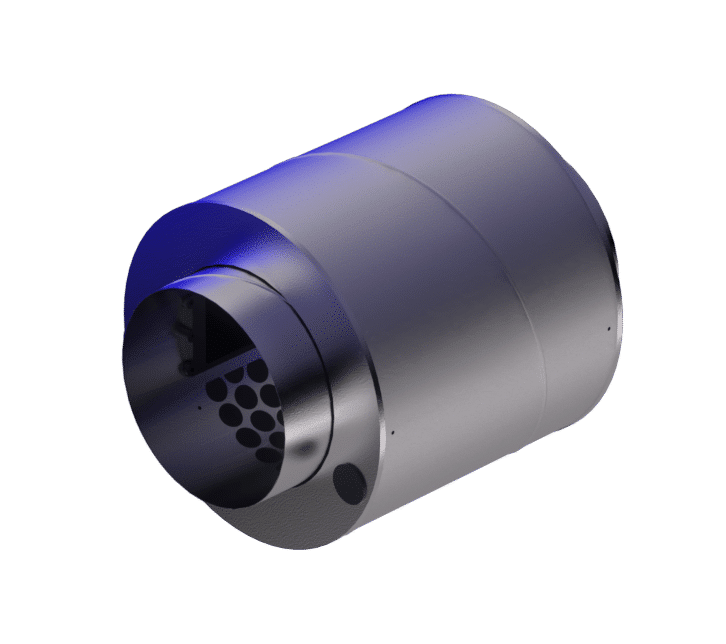
Vibiscus introduces a different way of approaching acoustic control. Rather than adding sound to neutralize existing noise, the technology acts directly on the acoustic behaviour of the surrounding air. Its operating principle combines a network of microphones with mobile membranes. Together, these elements modify local acoustic properties and create what can be described as an adaptive absorbing surface.
When air passes through the equipped structure, unwanted sound energy is absorbed and dissipated. Unlike conventional Active Noise Cancellation approaches, Vibiscus does not generate additional sound. Instead, it behaves more like an enhanced acoustic material capable of dynamically improving its effectiveness.
This architecture creates several advantages for data center environments. First, the system offers higher energy efficiency compared with solutions relying on a continuous sound generation. Second, its design allows integration into more complex airflow geometries where traditional solutions may become restrictive. Its compact and highly modular construction also supports easier deployment within existing infrastructures.
The technology additionally incorporates advanced AI capabilities to improve noise reduction precision.
For infrastructures expected to run continuously and evolve over time, the Vibiscus flexibility becomes increasingly valuable. Want to know more about our innovation data center noise reduction technology? Contact us!
The main source of noise comes from cooling and ventilation systems required to evacuate heat generated by servers and electrical equipment.
Poorly designed acoustic measures may interfere with airflow. Effective solutions must balance sound attenuation with thermal efficiency.
Traditional systems mainly rely on passive absorption or insulation. Vibiscus uses microphones and mobile membranes to adapt acoustic properties and absorb sound without generating additional noise.
Some technologies, especially compact and modular approaches, are designed to integrate into existing ventilation and technical infrastructures without major reconstruction work.