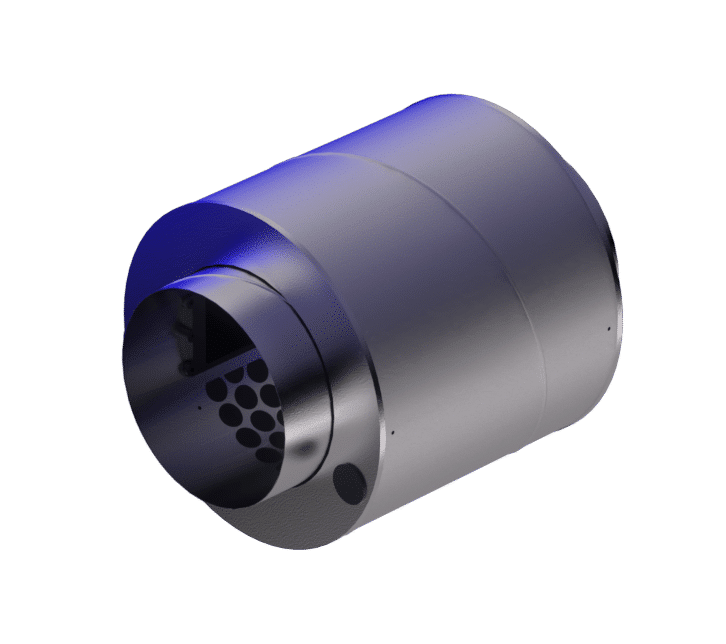
Heat pumps have become one of the most popular heating and cooling solutions for residential, commercial and industrial buildings. Their energy efficiency makes them an attractive alternative to conventional systems, but they also introduce a challenge that installers, manufacturers and property owners know well: noise. Although modern heat pumps are quieter than previous generations, they still generate sound through their compressors, fans and airflow. In densely populated environments or buildings where acoustic comfort is a priority, this noise can quickly become an issue. Vibiscus has developed a new approach that combines intelligent acoustic control, modularity and energy efficiency to create a heat pump sound attenuator capable of adapting to complex ventilation systems.
A heat pump produces several different types of noise simultaneously. The compressor generates mechanical vibrations as it compresses and circulates the refrigerant through the system. At the same time, the fan produces aerodynamic noise while drawing large volumes of air across the heat exchanger. Airflow itself also contributes to the overall acoustic signature. As air accelerates through protective grilles, ventilation ducts or confined spaces, turbulence creates additional sound that can propagate well beyond the equipment. In many installations, the surrounding environment amplifies these effects.
For this reason, simply choosing a quieter heat pump is not always enough. Acoustic treatment becomes necessary to improve user comfort and reduce the impact on neighbouring spaces.
Conventional sound attenuators address this challenge by incorporating sound-absorbing materials inside dedicated components installed within ventilation paths. While effective in many situations, these passive systems are designed with fixed acoustic properties that cannot adapt to changing operating conditions. As expectations for quieter buildings continue to increase, more flexible approaches to noise reduction are becoming increasingly valuable, such as the heat pump sound attenuator designed by Vibiscus.
At Vibiscus, we approached sound attenuation from a different perspective. Instead of relying exclusively on conventional absorbing materials, we developed an intelligent acoustic surface capable of modifying the acoustic properties of the surrounding air. Our technology combines a network of microphones with movable membranes. Together, these elements create an adaptive absorbing surface that removes unwanted sound energy as air passes through the system.
Unlike Active Noise Control (ANC), Vibiscus does not generate additional sound waves to cancel existing noise. Instead, it absorbs and dissipates sound directly. This distinction offers several important advantages. Because no counter-sound needs to be produced continuously, the solution is significantly more energy efficient than traditional active noise control systems. Its operating principle also allows integration into much more complex geometries than many conventional attenuation technologies.
Another major strength is its modular architecture. Heat pump installations rarely follow identical layouts. Ventilation paths differ from one building to another, available space varies considerably and integration constraints are often unique to each project. Our compact, highly modular design enables the system to adapt to a wide variety of air ducts and ventilation configurations without requiring extensive redesign of the existing installation. Rather than forcing the building to adapt to the acoustic treatment, the acoustic treatment adapts to the building.
Effective sound attenuation should never compromise the primary function of a heat pump. Heating and cooling performance depend on efficient airflow, making air management just as important as acoustic performance. This balance is one of the key objectives behind the Vibiscus technology. As air travels through our intelligent absorbing surface, unwanted noise is reduced while maintaining efficient airflow through the ventilation system.
Artificial intelligence further enhances this capability. By continuously adjusting the behaviour of the absorbing surface, the system achieves highly precise acoustic control adapted to real operating conditions. The result is a solution that combines several complementary benefits. It integrates seamlessly into existing ventilation structures, making it suitable for both new installations and retrofit projects.
Its compact design simplifies installation where available space is limited.
As buildings become increasingly focused on occupant well-being, innovative sound attenuation technologies provide new opportunities to create quieter indoor and outdoor environments without sacrificing energy performance. At Vibiscus, we believe that controlling noise should be as intelligent as controlling temperature. By combining adaptive acoustic materials, advanced artificial intelligence and flexible integration, we are helping redefine what a heat pump sound attenuator can achieve. Want to know more? Contact us.
A heat pump sound attenuator is a device designed to reduce the noise generated by heat pumps while allowing sufficient airflow for proper heating and cooling performance.
The primary sources are the compressor, the fan and the airflow passing through the system. Mechanical vibrations and aerodynamic turbulence combine to create the overall acoustic signature.
Traditional attenuators rely on passive acoustic materials with fixed properties. Vibiscus uses an intelligent absorbing surface that modifies the acoustic properties of the surrounding air, providing a more adaptable and energy-efficient approach.
No. Unlike ANC systems, Vibiscus does not emit additional sound waves. Instead, it absorbs and dissipates sound energy directly, making the solution more energy efficient while remaining compatible with complex ventilation geometries.