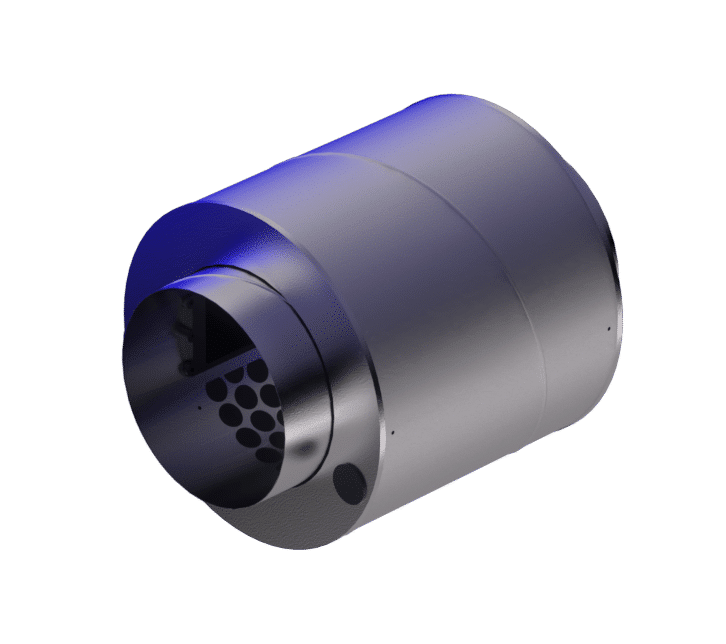
Noise from ventilation systems is one of the most underestimated nuisances in modern buildings. Found in homes, offices, hospitals, and production centers, ventilation systems are essential for ensuring constant air renewal, but they can quickly become sources of noise discomfort. Whistling, vibrations, rumbling: when ventilation disturbs the peace or distracts attention, it is quality of life, and sometimes even productivity, that suffers. So how can you reduce vent noise? Vibiscus tells you everything in this new article!
To ensure that a ventilation system remains efficient while remaining discreet, it is necessary to address the various possible sources of noise. These noises can come from the motor, mechanical vibrations, the speed of air flow, or turbulence created at certain points in the ducts.
The first step is therefore to check the condition and configuration of the network. Abnormal noise can be a sign of a partially blocked duct, a poorly secured grille, or an air inlet that is too narrow. Regular maintenance and checking that fasteners are tight can make a real difference.
It is then possible to adjust the air speed. Air flowing too quickly generates whistling noises. A slight reduction in flow, where technically possible, may be enough to significantly reduce noise without impacting air renewal quality.
Finally, in some cases, noise spreads through resonance in the building walls. Anti-vibration mounts can be used to isolate the motor-fan unit or ducts.
However, these solutions are limited. For lasting acoustic comfort, in most cases, the root of the problem must be addressed: the way sound travels through the ducts. If you are wondering how to reduce vent noise, here are some materials and equipment you may want to consider.
To effectively reduce noise, you need to absorb acoustic energy before it propagates. Several types of materials and devices can be used depending on the configuration:
Ducts lined with absorbent materials such as mineral wool, acoustic foam, or polyester fibers limit sound reflection in the ducts. They are effective at attenuating existing noise but have limitations:
Rectangular or cylindrical silencers, inserted into ductwork, also use porous material. They are effective at attenuating certain frequency bands, but their effectiveness depends heavily on the length of the silencer and the air velocity.
These solutions have proven their worth, but they remain passive. They do not adjust to variations in flow rate, changes in configuration, or more specific acoustic requirements. So, you’re probably wondering how to reduce vent noise effectively? It is to address these limitations that Vibiscus has developed a completely new technology, halfway between conventional approaches and active systems.
Vibiscus introduces a completely different way of treating noise in ventilation systems, based on a smarter and much more adaptable approach than traditional absorbent materials.
Our product is based on a network of microphones and movable membranes capable of dynamically modifying the acoustic properties of the surrounding air. Together, they form an absorbent surface configured to respond precisely to the noise encountered.
Unlike ANC (Active Noise Control) systems, Vibiscus does not add any sound to compensate for noise. It acts as an amplified acoustic material, capable of absorbing and dissipating sound waves with much greater efficiency than passive solutions.
Vibiscus thus takes building acoustic design to a new level, offering a tool that is truly adapted to modern constraints.
Our solution is suitable for residential buildings, offices, hotels, hospitals, laboratories, shopping centers, or any building with a ventilation or HVAC system that generates noise pollution.
It can replace them in some cases, but it can also complement them. Its flexibility allows it to be integrated into an existing installation.
Yes. One of the advantages of Vibiscus is its ability to be integrated without major structural modifications, even in older systems.