Cooling towers are essential components in many industrial and commercial facilities. They are widely used to dissipate heat generated by processes, HVAC systems or power generation equipment. While their thermal performance is critical, one aspect is often underestimated until it becomes problematic: noise. The acoustic impact of cooling towers can be significant in urban environments or near sensitive areas such as offices, hospitals or residential buildings. Continuous operation, large airflow volumes and mechanical components combine to produce a persistent and sometimes intrusive sound signature. That’s why you may wonder how to control noise from cooling towers? Vibiscus tells you everything in this post!
Cooling towers generate noise through several mechanisms, each contributing to the overall acoustic footprint of the installation. And one of the primary contributors is the fan system. Cooling towers rely on large fans to move air through the structure that allows heat exchange between water and air. The rotation of fan blades produces aerodynamic noise, which can be particularly noticeable at high speeds or when airflow is turbulent.
In addition to aerodynamic noise, mechanical noise is generated by the motor, gearbox and other moving components. Vibrations from these elements can propagate through the structure of the cooling tower and radiate into the surrounding environment.
Another significant source of sound is the water flow itself. As water cascades over fill media or falls within the tower, it creates a continuous noise similar to that of a waterfall. While this sound may appear less intrusive, it can contribute to the overall noise level, especially in large installations.
Airflow interactions within the tower also generate sound. As air passes through louvers, ducts and structural elements, it can generate additional noise due to turbulence and pressure variations.
Environmental conditions can amplify these effects. Reflections from nearby buildings or hard surfaces may increase perceived noise levels. Wind direction and atmospheric conditions can also influence how sound propagates from the cooling tower.
Because these sources often overlap, the resulting noise is complex and broadband in nature. This complexity makes noise control of the cooling towers particularly challenging, as different frequencies require different treatment approaches.
Reducing noise from cooling towers involves a combination of design considerations, mechanical improvements and acoustic treatments, in order to address noise at its source.
The first approach consists of optimizing the fan design and operation. Lower rotational speeds, improved blade geometry and proper maintenance can help reduce aerodynamic noise. However, these adjustments must be balanced with the cooling performance required by the system.
Mechanical noise can be mitigated through vibration isolation. Installing anti-vibration mounts or damping systems helps prevent vibrations from being transmitted to the supporting structure, reducing the amount of noise radiated externally.
Another commonly used solution involves the installation of acoustic barriers or enclosures. These structures are designed to block or absorb sound before it spreads to surrounding areas. While effective in some cases, they require careful design to ensure that airflow is not restricted.
Sound attenuators can also be integrated into airflow paths. These devices use absorbent materials to reduce noise as air passes through them. However, their efficiency depends on the frequency range of the noise and the available installation space.
Despite their widespread use, traditional passive solutions have limitations. They require significant physical space and may not be equally effective across all frequencies, particularly at lower frequencies where cooling tower noise can be prominent.
Additionally, cooling towers operate in dynamic conditions where airflow and noise levels can vary. Static acoustic treatments may not always adapt well to these variations. For these reasons, engineers are increasingly exploring advanced solutions capable of delivering more precise and adaptable noise control for cooling towers.
Innovative acoustic technologies are reshaping how industrial noise is managed. The solution developed by Vibiscus offers a different approach to noise control, particularly suited to complex airflow environments such as cooling towers.
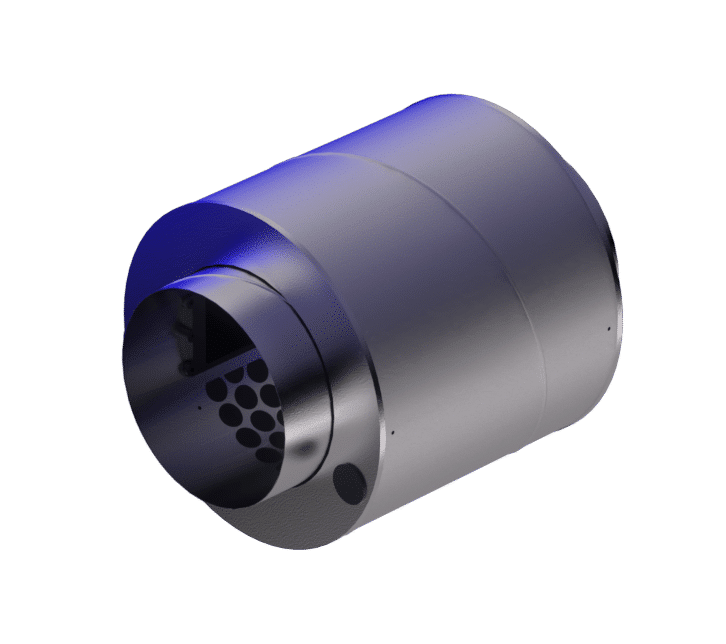
The Vibiscus system is based on a network of microphones and mobile membranes that can modify the acoustic properties of the surrounding air. This configuration creates a highly adaptable absorbing surface capable of responding to real acoustic conditions.
Unlike traditional active noise control systems, Vibiscus does not generate an opposing sound wave to cancel noise. Instead, it acts as an advanced material that absorbs and dissipates sound energy. When integrated into airflow paths, such as ventilation ducts or cooling tower air circuits, the system interacts directly with sound waves carried by the air. As air passes through the device, noise is reduced through controlled absorption.
One of the key advantages of this technology is its energy efficiency. Because it does not rely on continuous sound emission, it avoids the energy costs associated with conventional active noise control systems.
The compact and modular design of Vibiscus makes it suitable for integration into existing installations. This is particularly valuable in retrofit projects where space constraints limit the use of large acoustic structures.
Beyond acoustic benefits, the Vibiscus technology also contributes to improved airflow management. By maintaining efficient air circulation while reducing noise, it supports both operational performance and environmental comfort.
In the context of cooling towers, where noise is generated by a combination of airflow, mechanical components and water movement, such an adaptable solution offers a significant advantage over traditional methods.
Want to use our noise control for cooling tower devices? Contact us now or discover our products!
Cooling towers generate noise from fans, mechanical components, water flow and airflow turbulence, all of which combine to create a complex sound profile.
Complete elimination is rarely possible, but noise levels can be significantly reduced with proper design and acoustic treatment.
They can be effective, but they must be carefully designed to avoid restricting airflow and reducing system performance.
Vibiscus modifies the acoustic properties of air using a network of microphones and membranes that allows noise to be absorbed and dissipated without generating additional sound.
Yes, its modular design allows it to be integrated into existing systems, making it suitable for both new and retrofit projects.