Modern offices are designed to encourage collaboration, flexibility, and communication. Open-plan workspaces, shared meeting areas and hybrid working environments have become the norm in many organizations. While these layouts offer undeniable advantages, they also introduce a challenge that continues to affect employee well-being and productivity: noise. Conversations between colleagues, phone calls, office equipment, HVAC systems, and external environmental sounds can quickly create a distracting acoustic environment.
Traditional approaches have long relied on passive sound absorption materials or Active Noise Cancellation (ANC) technologies. Today, however, a new generation of sound control solutions is emerging. Vibiscus is part of this evolution, introducing a radically different way to manage noise in professional environments.
Vibiscus was developed to address one of the most persistent limitations of conventional noise reduction technologies: their inability to adapt efficiently to complex acoustic environments.
Unlike traditional acoustic panels that rely solely on passive absorption, Vibiscus combines advanced engineering, intelligent control systems, and adaptive acoustic surfaces to create a highly versatile office sound control solution.
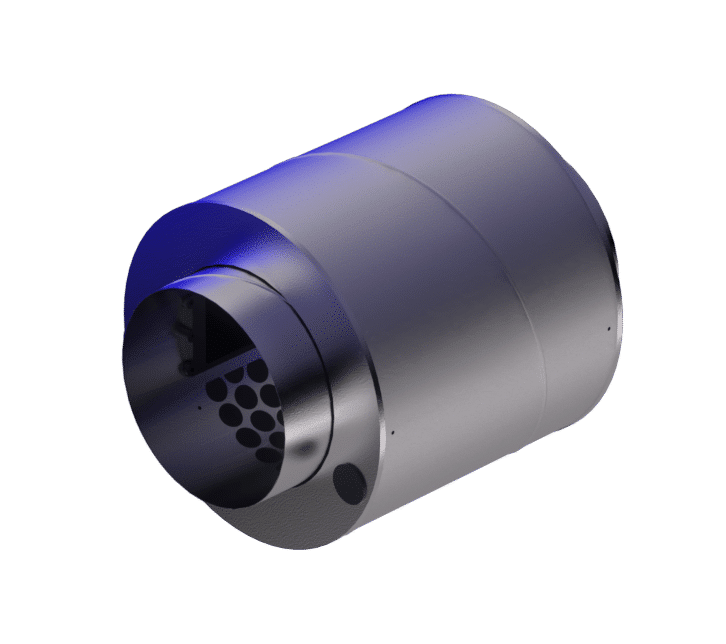
The core of the technology is a network of microphones and movable membranes capable of modifying the acoustic properties of the surrounding air. This creates an adaptive absorbing surface that can be configured according to specific noise conditions and operational requirements.
Instead of treating noise as a static problem, Vibiscus approaches sound management as a dynamic challenge. Office environments constantly evolve throughout the day. Meeting rooms become occupied, HVAC systems adjust airflow, employees move between workstations, and occupancy levels fluctuate. A fixed acoustic solution may struggle to maintain optimal performance under these changing conditions. Vibiscus was designed specifically to respond to this reality.
Its compact and highly modular architecture allows integration into a wide range of existing infrastructures. Although the technology was initially developed for ventilation and airflow applications, its underlying principles make it particularly relevant for environments where noise control is critical.
The result is a more intelligent and adaptable office noise reduction device capable of addressing acoustic issues with a level of precision that conventional approaches often cannot achieve.
When discussing advanced noise control, Active Noise Cancellation is often one of the first technologies that comes to mind. ANC systems work by generating sound waves that are phase-inverted relative to the unwanted noise. When these waves interact, they partially cancel each other out. This approach can be effective in specific situations, particularly in controlled environments or personal devices such as headphones. However, large-scale architectural and industrial applications present far greater challenges.
Office spaces contain multiple sound sources, reflective surfaces, changing occupancy levels, and highly variable acoustic conditions. Under these circumstances, deploying traditional ANC solutions becomes increasingly complex.
Vibiscus takes a fundamentally different approach. Rather than adding additional sound into the environment, our office noise reduction technology acts as what could be described as an enhanced acoustic material. It absorbs and dissipates unwanted noise instead of attempting to mask or cancel it through sound generation.
By avoiding the need to continuously generate compensating sound waves, Vibiscus offers a solution that is considerably more energy efficient. It also avoids some of the limitations associated with ANC systems in complex geometries and large-scale environments.
Noise control in offices is not simply about reducing sound levels. It is about creating an environment that supports concentration, communication, and employee well-being. This broader perspective explains why modern organizations increasingly seek solutions capable of addressing both acoustic performance and operational efficiency.
One of the primary advantages of Vibiscus is its adaptability. Because the technology relies on configurable absorbing surfaces, it can be adjusted to meet the specific requirements of different environments. A collaborative workspace does not generate the same acoustic profile as a meeting room, a technical office or a customer reception area. Vibiscus can be configured accordingly, helping organizations achieve a more balanced acoustic environment.
The integration of artificial intelligence further strengthens this capability. By continuously monitoring acoustic conditions, the system can respond with greater precision than traditional fixed solutions.
Another important benefit concerns integration. Retrofitting existing buildings often represents a major challenge when implementing noise reduction measures. Large structural modifications can be expensive, disruptive, and difficult to justify operationally.
Vibiscus was designed with integration in mind. Its compact and modular architecture facilitates implementation within existing infrastructures, reducing the complexity typically associated with acoustic improvement projects.
Vibiscus is not merely an office noise reduction device. It represents a broader approach to intelligent sound management within modern work environments.
Office noise typically originates from conversations, phone calls, office equipment, ventilation systems, HVAC installations and external environmental sounds. In open-plan offices, speech-related noise is often one of the most significant sources of distraction.
Unlike ANC systems, Vibiscus does not generate additional sound waves to cancel unwanted noise. Instead, it absorbs and dissipates sound through an adaptive acoustic surface, resulting in a more energy-efficient solution that can be applied to more complex environments.
Yes. One of the key advantages of the technology is its compact and modular design, which facilitates integration into existing structures without requiring major modifications.
No. The technology was designed to adapt to various applications where sound control is important. Its modular architecture allows integration into multiple environments, particularly those involving ventilation systems and airflow management.