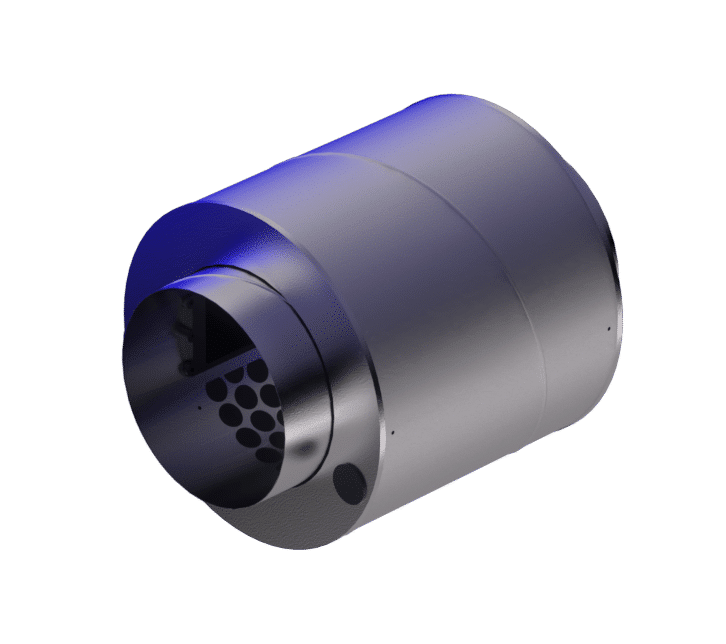
In modern architecture and industrial design, ventilation systems play an essential role in ensuring air quality, energy efficiency and comfort. Yet, one persistent challenge remains: noise. From subtle hums to constant mechanical drones, the sound emitted by air vents and ducts can becomes an invisible source of discomfort in residential, commercial, and industrial environments. But today, air circulation and silence should coexist. Our silent air vent solution was developed precisely to reconcile these two needs. It represents a new step in acoustic innovation. Want to know more? We tell you everything about it on this page.
Airflow, while vital, is rarely silent. The noise generated by HVAC systems (Heating, Ventilation, and Air Conditioning) comes from several combined factors such as the movement of air itself, some turbulence in ducts, the vibrations from fans or compressors and acoustic reflections within metal conduits.
In commercial buildings, hospitals, offices, and even private homes, these sounds can quickly become intrusive. A low-frequency rumble or a high-pitched whistling may seem minor, but over time, it contributes to fatigue, stress, and reduced concentration.
The problem intensifies in industrial or laboratory environments, where high-performance ventilation systems are essential to maintain controlled conditions. In such contexts, any disturbance can compromise both comfort and precision in the workspace.
Historically, designers have relied on passive acoustic materials to mitigate this issue. Traditional sound traps and foam absorbers reduce some frequencies, but they remain limited by their physical structure. Their effectiveness depends on the geometry of the duct or the specific frequency of the noise. As a result, engineers face a delicate balance: improve air circulation, and noise increases, reduce noise, and airflow suffers. It is precisely this paradox that Vibiscus set out to resolve with our new silent air vent solution.
The Vibiscus silent air vent solution marks a turning point in the field of acoustic engineering. Unlike conventional silencers that rely on static materials or bulky insulation, Vibiscus introduces an electroacoustic approach that is intelligent, dynamic and adaptable to any environment.
Our system is built around an innovative network of microphones and mobile membranes that modify the acoustic properties of the surrounding air in real time. By adjusting how the air interacts with the structure, the membranes transform the vent into an active sound-absorbing surface.
The design of our silent air vent solution allows for a custom configuration depending on the context. Whether integrated into a compact air duct in an office ceiling or a large industrial ventilation system, the Vibiscus solution continuously adapts to the flow and noise level detected. The result is a noticeable reduction in unwanted sound without compromising airflow or efficiency.
In practice, this means that the air moving through a Vibiscus-equipped system is purified of noise. Instead of simply masking the sound as active noise control (ANC) systems do by adding counter-noise, our technology absorbs and dissipates the unwanted vibrations themselves.
The experience for end users is immediate with a silent and comfortable environment where the presence of the ventilation system fades into the background.
Vibiscus stands at the crossroads of mechanical acoustics and artificial intelligence. By combining both disciplines, our engineers have developed a silent air vent solution that truly redefines how we perceive silence in air management.
The core innovation lies in what we call a “boosted material”: a surface whose acoustic properties can be modified in real time. Unlike passive materials that remain fixed in their absorption potential, this smart surface interacts dynamically with its environment.
When air passes through the system, built-in microphones capture the acoustic signature of the flow. The data is instantly processed by an embedded algorithm that adjusts the behavior of the membranes accordingly. In other words, the surface reacts, self-tunes, and optimizes its absorption to neutralize noise across a wide range of frequencies.
Our new approach provides an answer to the two traditional limitations of HVAC acoustics: energy consumption and geometric constraints.
Traditional silencers rely on passive absorption materials that trap specific sound frequencies. The Vibiscus solution, on the other hand, uses electroacoustic control to adapt in real time, offering far more precise and consistent noise reduction across all frequency ranges.
Not at all. Vibiscus is designed to maintain optimal airflow. The membranes interact with the air without obstructing it, ensuring that ventilation efficiency remains uncompromised.
Yes. The Vibiscus silent air vent solution was initially developed for industrial settings, where ventilation is both powerful and continuous. Its robust design and modular configuration make it equally suitable for commercial buildings and public infrastructures.
The solution is custom-designed to fit each client’s existing duct geometry.
The silent air vent solution by Vibiscus embodies a shift in how we approach noise management in HVAC systems. Rather than treating sound as a by-product to be contained, Vibiscus integrates acoustic control into the very heart of airflow design. Want to know more about it? Contact us now to exchange about your needs!