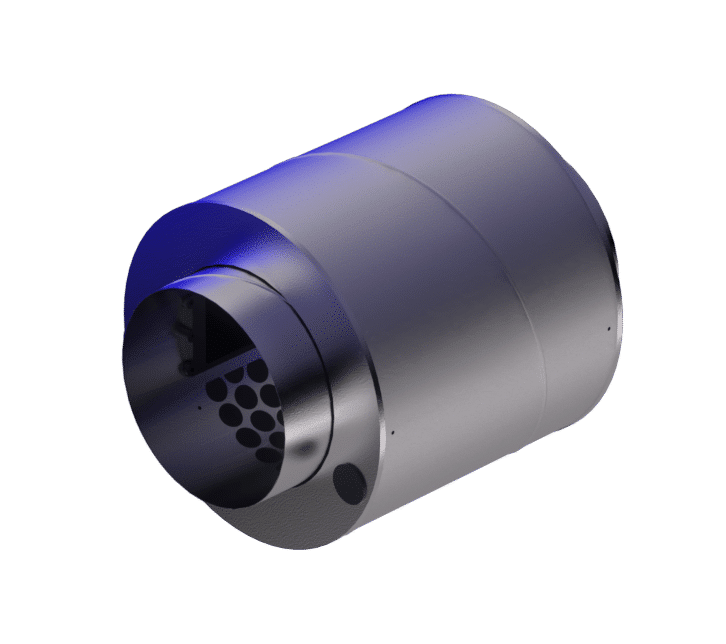
In many buildings, from individual homes to the largest commercial infrastructures, acoustic comfort largely depends on the quality of ventilation and air conditioning systems. While their primary role is to ensure reliable and continuous air renewal, their operation can generate noise that significantly degrades the perception of comfort. It is precisely to address this issue that the sound attenuator for HVAC systems has emerged, a device that has become essential in the design of modern and efficient HVAC systems. With Vibiscus, this concept is entirely reinvented to meet the contemporary challenges of airborne noise control.
Mechanical ventilation, whether provided by a centralized MVHR system, a complete HVAC system or stand-alone units, is responsible for many forms of noise pollution. The noise generated can be continuous, impulsive or fluctuating depending on the fan speed, the pressure in the ducts or the condition of the network. This phenomenon is not inevitable; it is the result of well-known physical principles.
The primary source of noise comes from the air itself. The higher the flow rate, the more turbulent the airflow becomes, because it generates acoustic vibrations in the ducts. Added to this are the mechanical vibrations from motors, fan coil units, compressors and turbines. Even pressure variations due to changes in cross-section or bends create aerodynamic shocks that generate noise.
In industrial settings or multi-unit buildings, these nuisances can be amplified by the length of the ducts. The noise then circulates as if in a resonating chamber. Over time, it becomes a real source of annoyance and cause loss of concentration at work, difficulty sleeping in homes and increased stress in public spaces.
That’s why the sound attenuator for HVAC systems occupies a central position: it is the device placed at the heart or periphery of the network to reduce noise without creating excessive pressure losses. Historically based on conventional absorbent materials, it is now evolving towards a new generation of technologies capable of intelligent and adaptive intervention. And Vibiscus is precisely part of this dynamic!
Vibiscus has established itself as an innovative player in noise reduction for ventilation networks. We offer a product that radically departs from conventional solutions such as bulky silencers or ducts lined with absorbent materials.
The traditional approach consists of inserting a passive absorber into a duct to dissipate acoustic energy. This method remains effective for certain frequencies but shows its limitations as soon as the geometry of the ducts becomes complex or when the frequencies produced by the system vary.
Vibiscus takes the opposite approach to these solutions thanks to a novel principle. Our sound attenuator for HVAC systems is based on a network of microphones and movable membranes. These modify the acoustic properties of the surrounding air in real time. In other words, the absorbing surface is not static: it is configured, adjusted and optimized for each application.
Unlike ANC (Active Noise Control) systems, which add counter-noise to cancel out the sound source, Vibiscus does not generate any additional sound. It acts like a “doped” material, capable of absorbing and dissipating sound energy far more effectively than a conventional absorber. The absence of compensatory noise is a significant advantage, particularly for applications requiring high environmental stability, such as laboratories, cleanrooms, hospitals or spaces with stringent acoustic requirements.
Compact and highly modular, our sound attenuator for HVAC systems can be integrated into a wide variety of existing ductwork without extensive modifications. Thanks to the flexibility of its absorbing surface, it can be installed in environments where conventional silencers would be impossible to implement.
Acoustic comfort influences concentration, mental health, sleep quality and even productivity. In both commercial and residential buildings, it is becoming a major architectural consideration. The use of a sound attenuator for HVAC systems developed by Vibiscus addresses three essential objectives:
Our sound attenuator for HVAC systems is suitable for offices, hotels, schools, industrial sites and hospital complexes. Thanks to its intelligent approach, it treats noise at the source and maintains a stable sound level, even when the HVAC system’s intensity varies.
Any acoustic intervention in a ventilation system must adhere to one imperative: aerodynamic performance. With Vibiscus, air circulates freely, without obstruction and does not accumulate dust or fibers as in some conventional sound-absorbing devices.
Noise represents a hidden cost for many businesses: acoustic correction services, duct replacements, investments in additional silencers and reduced comfort for occupants. By offering a durable, modular and energy-efficient device, Vibiscus becomes a cost-effective alternative.
It is a device designed to reduce noise generated by ventilation, heating, and air-conditioning systems. In conventional setups, it typically involves passive silencers or duct linings. Vibiscus reinvents this technology with an active-surface absorber.
Yes, in many situations. Its ability to adapt to different geometries and frequency ranges can surpass the performance of passive silencers.
Absolutely. The compact and modular design of our sound attenuator for HVAC systems allows integration into most duct configurations without requiring major modifications.
Whether you are designing a new HVAC installation or improving an existing one, the Vibiscus engineering team is available to analyze your needs and propose tailored technical recommendations.
Want to know more about our sound attenuator for HVAC systems? Contact us now.