In a laboratory environment, silence is rarely a luxury. It is a prerequisite for accuracy, concentration and reliability. Whether in research facilities, testing centers, or industrial R&D units, noise can directly interfere with measurements, disrupt workflows and degrade working conditions. As laboratory infrastructures become more complex, integrating ventilation systems, high-performance equipment, and continuous monitoring devices, controlling acoustic disturbances have become a technical challenge in its own right. To help you better understand the sources of noise and control them, Vibiscus tells you everything you need to know about noise control for laboratories in this post.
Laboratories are unique spaces where precision is paramount. Unlike conventional industrial settings, where noise is accepted as an operational by-product, laboratories demand controlled environments. Even relatively moderate noise levels can introduce variability into sensitive experiments or reduce the ability of personnel to focus over extended periods.
Several sources contribute to this acoustic complexity. Ventilation and HVAC systems are among the most significant contributors. These systems are indispensable for maintaining air quality, temperature and safety conditions, yet they generate continuous airflow noise, turbulence and vibrations within ducts and diffusers.
Equipment used in laboratories also plays a role. Pumps, compressors, cooling systems and analytical instruments all emit noise, sometimes intermittently, sometimes continuously. When multiple devices operate simultaneously, their combined acoustic footprint can create a diffuse and persistent background noise.
Another often underestimated factor is the architectural design of laboratory spaces. Hard surfaces, necessary for cleanliness and durability, tend to reflect sound rather than absorb it. This leads to reverberation, amplifying the perception of noise even when the original source is relatively moderate.
The challenge, therefore, is not limited to reducing sound at its source. It involves managing how sound propagates, reflects and accumulates within a controlled environment. And so, you may wonder which solutions can use laboratories for noise control?
Over the years, several approaches have been developed to mitigate noise in laboratory settings. Each addresses a specific aspect of the problem and their effectiveness depends on how well they are combined.
The first approach typically involves passive acoustic treatment. This includes the use of sound-absorbing materials on walls, ceilings or within ventilation ducts. These materials reduce reflections and limit reverberation, improving overall acoustic comfort. However, their performance can be constrained by space limitations, hygiene requirements, and compatibility with laboratory standards.
Another common strategy is mechanical isolation. By decoupling noisy equipment from structural elements (using mounts or dampers), it is possible to limit the transmission of vibrations. This method is particularly useful for equipment such as pumps or compressors, which generate structure-borne noise.
Active Noise Control (ANC) represents a more advanced solution. It relies on generating sound waves that are phase-inverted relative to the noise source, effectively canceling it out. While this technique can be effective in controlled conditions, it requires precise calibration and continuous energy input. Its applicability may also be limited in complex geometries or in environments where noise sources vary.
Silencers integrated into ventilation systems are another widely used solution. These devices are designed to attenuate sound as air flows through ducts. While effective to a certain extent, traditional silencers can introduce pressure losses and may not adapt easily to evolving configurations.
What becomes evident is that each of these solutions addresses only part of the problem. Laboratories, with their evolving layouts and stringent requirements, need more adaptable and efficient technologies. And that’s where you can turn to an innovative noise control device for laboratories.
In this context, Vibiscus introduces a fundamentally different approach to noise control: one that bridges the gap between passive and active methods.
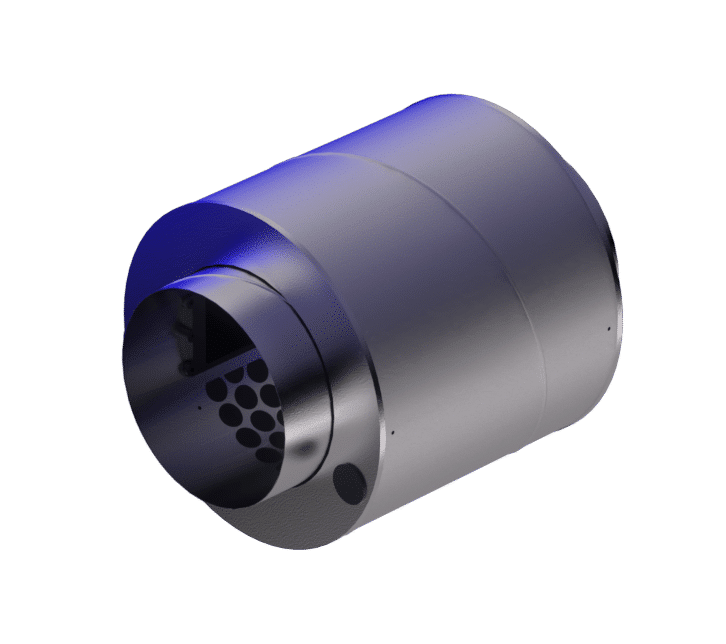
Rather than adding sound to cancel noise, or relying solely on static absorbing materials, Vibiscus technology modifies the acoustic properties of the air itself. This is achieved through a network of microphones and mobile membranes that interact dynamically with the surrounding environment.
As air passes through the system, it encounters a configurable absorbing surface capable of dissipating noise efficiently. Unlike traditional materials, which offer fixed performance, this solution can be tuned to match specific acoustic conditions. Its compact and highly modular design makes it particularly well suited for laboratory environments. Integration into existing ventilation ducts is seamless and avoids the need for major structural modifications.
Another notable aspect is energy efficiency. By focusing on absorption and dissipation rather than sound generation, the system avoids the continuous energy consumption associated with active noise control. This contributes not only to operational efficiency but also to overall sustainability. The integration of advanced algorithms further enhances performance. By analyzing acoustic data in real time, the system can adjust its behavior to maintain optimal noise reduction.
Beyond pure noise reduction, Vibiscus also contributes to improved airflow management. By maintaining efficient ventilation while reducing acoustic disturbances, it supports both comfort and safety, two critical dimensions in laboratory operations.
In essence, this technology represents a balanced solution of noise control for laboratories, capable of addressing complex acoustic challenges without compromising on flexibility or performance. Want to know more? Discover the products right now.
Because noise can interfere with sensitive measurements, reduce concentration and negatively impact working conditions.
Ventilation systems, pumps, compressors and other technical equipment are the primary contributors.
They can be effective in certain cases, but often lack adaptability and may not fully address complex acoustic environments.
It does not generate additional sound. Instead, it modifies the acoustic properties of air to absorb and dissipate noise more efficiently.
Yes, its modular design allows for seamless integration into existing ventilation ducts without major modifications.
Want to know more about the Vibiscus data center noise reduction solution? Discover our products right now.